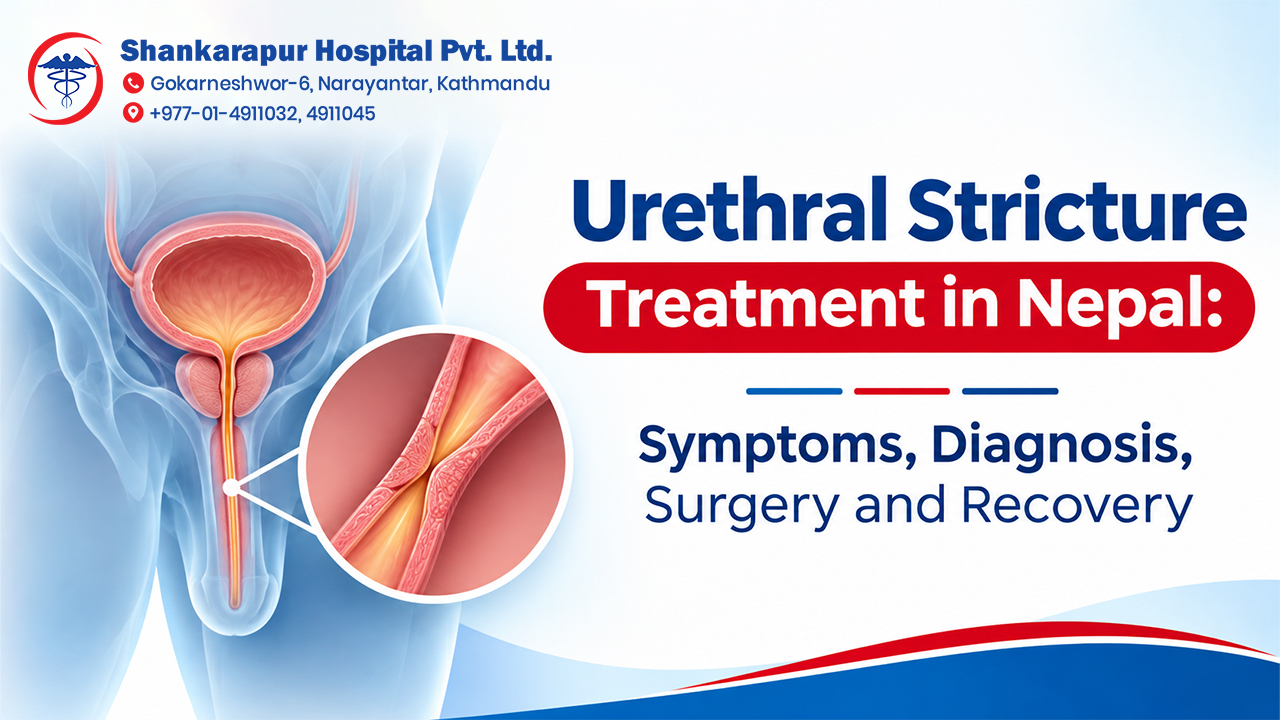
A weak urine stream, difficulty passing urine or a feeling that your bladder never empties completely can be signs of several urinary conditions. One possible cause is a urethral stricture, a narrowing of the tube that carries urine from the bladder out of the body.
Urethral stricture treatment depends on the location and length of the narrowing, how much scar tissue is present, whether you have received treatment before, and your overall health. Options may include urethral dilation, direct vision internal urethrotomy (DVIU), or reconstructive surgery called urethroplasty.
Not everyone needs the same procedure. A urologist must first determine the cause and severity of the problem.
If you are experiencing persistent urinary difficulties in Nepal, learning about the condition can help you prepare for an appropriate medical assessment. You can also explore Shankarapur Hospital's urology department for information about its published urology services in Kathmandu.
What Is a Urethral Stricture?
A urethral stricture is an abnormal narrowing of the urethra, usually caused by scar tissue.
The urethra is the passage through which urine leaves the bladder. When part of this tube becomes narrowed, urine may have difficulty passing through it. This can make urination slower, uncomfortable or incomplete.
Some people develop symptoms gradually, while others experience more noticeable difficulty passing urine.
Urethral strictures occur more commonly in males, but they can also affect females. The causes, diagnostic approach and surgical options may differ.
According to Mayo Clinic's explanation of urethral stricture, scar tissue that narrows the urethra can interfere with urinary flow and contribute to urinary tract problems.
Is a urethral stricture dangerous?
A urethral stricture should not be ignored, particularly when symptoms are worsening.
A significant narrowing can make it difficult to empty the bladder. Possible complications include recurrent urinary tract infections, urinary retention and, in severe untreated cases, damage to the upper urinary tract.
However, not every stricture causes severe symptoms or requires immediate surgery. Treatment decisions depend on the clinical findings.
Seek emergency medical care if you are unable to pass urine, especially when you have a painful or swollen lower abdomen.
Symptoms of Urethral Stricture
Symptoms usually result from difficulty moving urine through the narrowed urethra.
Common symptoms include:
-
A weak or slow urine stream
-
Straining or taking longer to urinate
-
Difficulty starting urination
-
Urine spraying or splitting into different streams
-
A sensation of incomplete bladder emptying
-
Frequent urination or urgency
-
Dribbling after urination
-
Pain or burning during urination
-
Recurrent urinary tract infections
Some people also experience pelvic discomfort or blood in the urine.
These symptoms are not specific to urethral stricture. They may also occur with prostate enlargement, infections, bladder dysfunction or other urinary conditions.
The European Association of Urology (EAU) diagnostic guidance emphasizes clinical history, examination and appropriate investigations rather than relying on symptoms alone.
When should you see a doctor?
Arrange a medical assessment if you notice a persistent weak stream, difficulty emptying your bladder or repeated urinary infections.
Do not wait for symptoms to become severe before seeking advice.
Get urgent medical attention if you suddenly cannot urinate, have fever with significant urinary symptoms, or develop severe urinary pain. These situations may require prompt investigation and treatment.
What Causes Urethral Stricture?
Urethral strictures generally develop when injury or inflammation causes scar formation within or around the urethra.
1. Previous catheterization or urinary procedures
A urinary catheter is a tube inserted to drain urine from the bladder. Catheter insertion and other instruments passed through the urethra can occasionally cause injury, particularly if instrumentation is difficult or repeated.
Healing after injury may result in narrowing.
2. Injury or trauma
Trauma involving the pelvic region, penis or perineum can damage the urethra.
For example, a pelvic fracture following a serious road accident or a straddle injury can sometimes cause urethral damage.
3. Infection and inflammation
Certain infections, including some sexually transmitted infections that cause urethritis, may contribute to urethral scarring.
Persistent inflammation can also affect the urethra.
Not every urinary tract infection leads to a stricture, and infection should not automatically be assumed to be the cause.
4. Lichen sclerosus
Lichen sclerosus is an inflammatory skin condition that can affect the genital area and contribute to narrowing of the urinary opening or urethra.
This condition can influence the choice of reconstructive surgery.
5. Previous surgery or radiation
Some urinary or pelvic procedures, including certain prostate treatments, may be associated with urethral narrowing or related scar-related obstruction.
6. Unknown causes
In some patients, no definite cause is identified. These are often described as idiopathic strictures.
A urologist will ask about previous injuries, procedures, infections and treatments to help identify the likely cause.
How Is Urethral Stricture Diagnosed?
Diagnosing a urethral stricture involves more than checking whether the urine stream is weak.
The aim is to confirm that narrowing exists, understand its location and length, evaluate how it affects urination, and determine the most appropriate treatment.
Medical history and examination
Your urologist may ask when the symptoms began, whether they are getting worse, and whether you have experienced urinary infections, injuries, catheterization or previous urinary surgery.
If you have already undergone dilation or DVIU, that information is particularly important.
Urine tests
A urine test can help identify possible infection, blood or other abnormalities.
When infection is suspected, a urine culture may be recommended to identify the responsible organism and guide antibiotic selection.
Uroflowmetry
Uroflowmetry measures the rate and pattern of urine flow.
During this test, you urinate into a device that records how quickly urine passes.
Reduced flow may suggest obstruction, although the result does not independently confirm a urethral stricture.
Post-void residual measurement
A post-void residual test estimates how much urine remains in the bladder after urination.
It is commonly performed using ultrasound.
A large residual volume may suggest difficulty emptying the bladder and requires interpretation alongside other clinical findings.
Retrograde urethrogram (RUG)
A retrograde urethrogram is an imaging investigation in which contrast material is introduced into the urethra and X-ray images are taken.
It helps identify the position and approximate length of a narrowing.
For patients being considered for reconstructive surgery, this information can be particularly valuable.
Cystoscopy
Cystoscopy involves using a small camera to examine the urinary passage.
It allows the urologist to directly identify a narrowed area and assess other abnormalities.
Depending on the circumstances, cystoscopy may complement rather than replace imaging.
The EAU guidelines on diagnostic evaluation describe these investigations as components of comprehensive stricture assessment.
Not every patient needs every investigation. Your urologist will choose tests according to your symptoms, medical history and proposed management.
Urethral Stricture Treatment Options
The main treatment objective is to improve urinary drainage, reduce bothersome symptoms and manage the risk of future narrowing.
The most suitable treatment depends on individual anatomy and disease characteristics.
1. Urethral dilation
Urethral dilation is a procedure that gradually widens a narrowed part of the urethra using specialized instruments or a balloon.
It does not remove the underlying scar tissue.
When may dilation be considered?
Dilation may be appropriate for certain short, uncomplicated strictures, particularly when a minimally invasive approach is suitable.
It can also be used in selected situations where definitive reconstructive surgery is not possible or is being deferred.
Potential benefits
Dilation is less invasive than open reconstruction and may improve urinary flow without a larger surgical incision.
Some patients can recover relatively quickly, although the exact recovery period varies.
Limitations
The narrowing may return because the scar tissue remains.
Repeated dilation is not automatically the best long-term strategy. In some circumstances, repeated instrumentation can worsen the condition or make later reconstruction more complex.
A urologist should explain whether dilation offers a reasonable long-term prospect or mainly temporary symptom relief.
2. Direct Vision Internal Urethrotomy (DVIU)
DVIU is an endoscopic procedure used to open certain urethral strictures.
A surgeon passes a specialized instrument through the urethra and makes an incision in the scar tissue to widen the narrowed segment.
Because the procedure is performed through the urinary passage, an external surgical incision is generally unnecessary.
Who may benefit from DVIU?
DVIU may be considered for a carefully selected patient with a first-time, short, non-obliterative stricture in the bulbar urethra.
It may also have a role in selected short recurrences following previous reconstruction.
However, DVIU is less suitable for many long, complex or repeatedly recurrent strictures.
The EAU guidance on managing male urethral strictures recommends against DVIU for penile strictures and against using DVIU or dilation alone for long strictures exceeding 2 cm.
Benefits and risks
DVIU is less invasive than open urethral reconstruction and may improve flow in appropriate cases.
Possible risks include bleeding, infection, urethral injury and recurrence.
A temporary urinary catheter is commonly used after treatment.
The most important limitation is that opening the narrowed area does not necessarily prevent further scar formation.
3. Urethroplasty: Reconstructive surgery
Urethroplasty is surgery designed to repair or reconstruct the narrowed urethra.
It is an important treatment option for recurrent, longer or more complex strictures, and it may also be appropriate as initial treatment for selected shorter strictures.
Unlike dilation or DVIU, which open the existing narrowing, urethroplasty aims to reconstruct the affected segment.
Excision and primary anastomosis
In selected short strictures, the surgeon may remove the scarred segment and reconnect the healthy ends of the urethra.
Suitability depends on location, tissue condition and the length of the affected area.
This approach is not appropriate for every stricture because removing too much tissue or creating tension can cause complications.
Graft urethroplasty
For some longer strictures, additional tissue may be used to enlarge or reconstruct the urethra.
A common graft source is the lining inside the cheek, known as buccal mucosa.
The surgical technique depends on the affected location, extent of scarring and condition of surrounding tissues.
Is urethroplasty permanent?
Urethroplasty can provide durable improvement, but it cannot guarantee that narrowing will never return.
The likelihood of recurrence depends on factors such as stricture characteristics, surgical technique, previous treatments and underlying conditions.
Patients should discuss expected benefits, potential complications and follow-up requirements with their surgeon.
Possible complications include infection, bleeding, urinary leakage, recurrence and changes in sexual or urinary function, depending on the procedure.
The American Urological Association guideline recommends offering urethroplasty rather than repeated endoscopic treatment for many recurrent anterior strictures following unsuccessful dilation or DVIU.
4. Drug-coated balloon treatment
Drug-coated balloon dilation combines mechanical widening with delivery of medication intended to reduce recurrent scar-related narrowing.
It may be an option for selected patients with recurrent bulbar strictures.
Its suitability depends on the clinical indication, available evidence, local equipment and regulatory considerations.
It is not established as the appropriate first choice for every patient.
The 2026 EAU guideline summary describes drug-coated balloon treatment as a promising second-line endoluminal option for selected bulbar strictures.
Availability at Shankarapur Hospital has not been confirmed.
5. Observation or supportive management
Not every detected stricture requires an immediate procedure.
In selected patients with an incidental narrowing, no significant symptoms and reassuring clinical findings, a urologist may recommend observation and follow-up.
Where definitive surgery is unsuitable, individualized approaches such as intermittent catheterization or planned procedures may sometimes be used to maintain drainage.
These approaches should be discussed and supervised by a specialist.
Patients should never attempt urethral dilation or catheterization themselves without appropriate clinical assessment and training.
Comparing Urethral Stricture Treatments
| Treatment | Typical consideration | Important limitation |
|---|---|---|
| Urethral dilation | Selected short strictures or symptom management | Recurrence can occur |
| DVIU | Selected short, non-obliterative bulbar strictures | Less suitable for long or repeatedly recurrent disease |
| Urethroplasty | Recurrent, long or complex strictures; selected initial cases | More invasive, with surgical recovery and risks |
| Drug-coated balloon | Selected recurrent bulbar strictures | Not suitable or available in every setting |
| Observation | Carefully selected asymptomatic narrowing | Requires monitoring for progression |
No single procedure is universally best. Treatment must be tailored to the patient.
How Do Doctors Choose the Right Treatment?
Two patients may have similar symptoms but require different treatment strategies.
A urologist typically considers several factors.
Location of the stricture: Narrowing near the urinary opening, penile urethra or bulbar urethra may require different approaches.
Length and severity: A short, partially narrowed segment may be treated differently from a long or nearly blocked segment.
Previous procedures: A stricture that has returned after repeated dilation may call for a different approach from a first-time stricture.
Tissue condition: Significant scarring, inflammation, prior injury or lichen sclerosus can affect procedure selection.
General health and preferences: Surgical fitness, expected recovery, personal priorities and tolerance for recurrence risk are also relevant.
The 2026 EAU guideline summary published in European Urology emphasizes individualized decision-making when choosing endoscopic treatment and considering referral for urethroplasty.
Before agreeing to treatment, ask your urologist which option is most appropriate for your particular stricture and why.
Preparing for Urethral Stricture Treatment
Preparation depends on the procedure being considered.
Your healthcare team may review your medical history, medications, allergies and previous urinary investigations.
Urine testing may be required to identify infections that should be treated before an elective procedure.
If anesthesia is planned, additional assessments may be necessary.
Patients undergoing reconstructive surgery may receive specific instructions about catheter use, wound care and the recovery period.
Before your consultation, bring any previous imaging, urine test reports and records of catheterization or urinary surgery.
It can also be helpful to note how long symptoms have been present and whether they have changed.
Recovery After Treatment
Recovery differs significantly between minimally invasive treatment and urethral reconstruction.
Recovery after dilation or DVIU
Some patients experience temporary discomfort, burning or minor bleeding after the procedure.
A urinary catheter may be required for a period determined by the treating clinician.
Follow the instructions provided regarding catheter management, medications, activity and follow-up.
Contact your treating team if symptoms worsen or you develop fever, significant bleeding or difficulty draining urine.
Recovery after urethroplasty
Urethroplasty typically requires a longer recovery period.
A catheter commonly remains in place while the reconstructed segment heals. Depending on the operation, imaging or other evaluation may be performed before catheter removal.
Patients may need to limit heavy physical activity and certain forms of exercise during early recovery.
The surgeon should provide individualized advice about bathing, wound care, returning to work, sexual activity and follow-up appointments.
Do not remove a urinary catheter or restart strenuous activity earlier than instructed.
What should you expect after catheter removal?
Many patients notice an improvement in urinary flow following successful treatment.
However, symptoms can fluctuate during recovery and improvement is not guaranteed.
Your urologist may assess urine flow and residual urine and ask whether symptoms have improved.
Seek medical advice promptly if you develop a progressively weaker stream, increasing pain, inability to urinate or signs of infection.
Can Urethral Stricture Come Back After Treatment?
Yes. A urethral stricture can recur after treatment.
Recurrence occurs when scar tissue causes the passage to narrow again.
The risk is not identical for every procedure or every patient.
Endoscopic treatments may be useful in selected cases, but repeated DVIU or dilation often becomes less effective when the narrowing repeatedly returns.
Reconstructive surgery may provide a more durable solution for appropriately selected patients, although it also carries recurrence risks.
If symptoms return, another assessment is important. The same treatment should not automatically be repeated without reconsidering the anatomy and previous outcomes.
The EAU follow-up guidance recommends monitoring after surgery because recurrence may sometimes be present even before noticeable symptoms develop.
Urethral Stricture Treatment in Nepal: What Patients Should Know
If you are looking for urethral stricture treatment in Kathmandu or elsewhere in Nepal, begin by seeking a qualified urology assessment.
Before choosing a hospital or procedure, consider whether the healthcare provider can evaluate the stricture appropriately and explain the available treatment options.
You may wish to ask whether the recommended investigations are available, whether reconstructive urology consultation is appropriate, and what follow-up arrangements are provided.
What is the cost of urethral stricture treatment in Nepal?
The cost depends on several factors, including:
-
Consultation and diagnostic investigations
-
Type of procedure
-
Operating theatre and anesthesia requirements
-
Hospital admission and length of stay
-
Catheters, medicines and follow-up visits
-
Possible additional treatment for recurrence or complications
Because treatment pathways differ, there is no single reliable price for every patient.
Ask the healthcare provider for a written estimate based on the proposed procedure, including expected follow-up costs.
Urology consultation at Shankarapur Hospital
Shankarapur Hospital has a published urology department providing assessment and care for urinary tract conditions.
The hospital is located at Gokarneshor-06, Jorpati, Narayantaar, Kathmandu, Nepal.
If you have symptoms of urethral narrowing, you can request a urology consultation or contact Shankarapur Hospital to discuss the appropriate next step.
Before arranging a specific urethral-stricture procedure, confirm directly whether the hospital provides that treatment or can advise on specialist referral.
Frequently Asked Questions About Urethral Stricture Treatment
Can medicine cure a urethral stricture?
Medication does not generally remove established scar tissue that has narrowed the urethra.
However, medications may be used to treat associated conditions, such as a bacterial infection, when clinically indicated.
A urologist should determine whether the symptoms are caused by a stricture or another condition.
Can a urethral stricture heal on its own?
An established scar-related stricture generally does not disappear spontaneously.
Some minor, asymptomatic narrowings may be observed under specialist supervision, but persistent or worsening urinary obstruction requires assessment.
Is urethral stricture surgery painful?
Procedures are performed with appropriate anesthesia or pain management.
Discomfort may occur afterward, and the recovery experience varies according to the operation.
Discuss anesthesia, expected pain and pain-control options with the treating team.
Which treatment is best for a recurrent urethral stricture?
The choice depends on the length, location and severity of the recurrent narrowing and the procedures already performed.
Urethroplasty is often considered after unsuccessful endoscopic treatment, but decisions must be individualized.
Can women develop urethral strictures?
Yes. Female urethral strictures are less common and can cause poor urinary flow, urgency, frequency or incomplete emptying.
Treatment options may include dilation or reconstruction in selected cases. The clinical approach is not identical to that used for male strictures.
How long does urethral stricture treatment take?
The time required varies according to the investigation and procedure.
A minimally invasive procedure and a complex urethral reconstruction differ in operating time, catheter requirements and recovery.
Your healthcare team can give an estimate after determining the proposed treatment.
Can a urethral stricture affect sexual health?
The condition itself and some treatments may affect sexual function, depending on the location of the disease, pre-existing symptoms and surgical approach.
Discuss any concerns about erection, ejaculation, sensation or sexual activity before treatment.
Final Thoughts: Get the Right Diagnosis Before Choosing Treatment
Urethral stricture treatment is not a one-size-fits-all process.
A short, first-time stricture may require a different approach from a long or recurrent narrowing. Understanding the exact location and severity of the disease is essential before choosing between dilation, DVIU, urethroplasty or another management option.
If you have persistent difficulty passing urine, a weak stream or repeated urinary problems, seek advice from a qualified urologist.
For patients in Kathmandu, Shankarapur Hospital's urology department provides information about its published urology services. You can also book an appointment for appropriate assessment and advice.
Medical review required before publication: [Reviewer name/credentials to be added after actual review].
This article provides general educational information and does not replace individualized medical diagnosis or treatment.