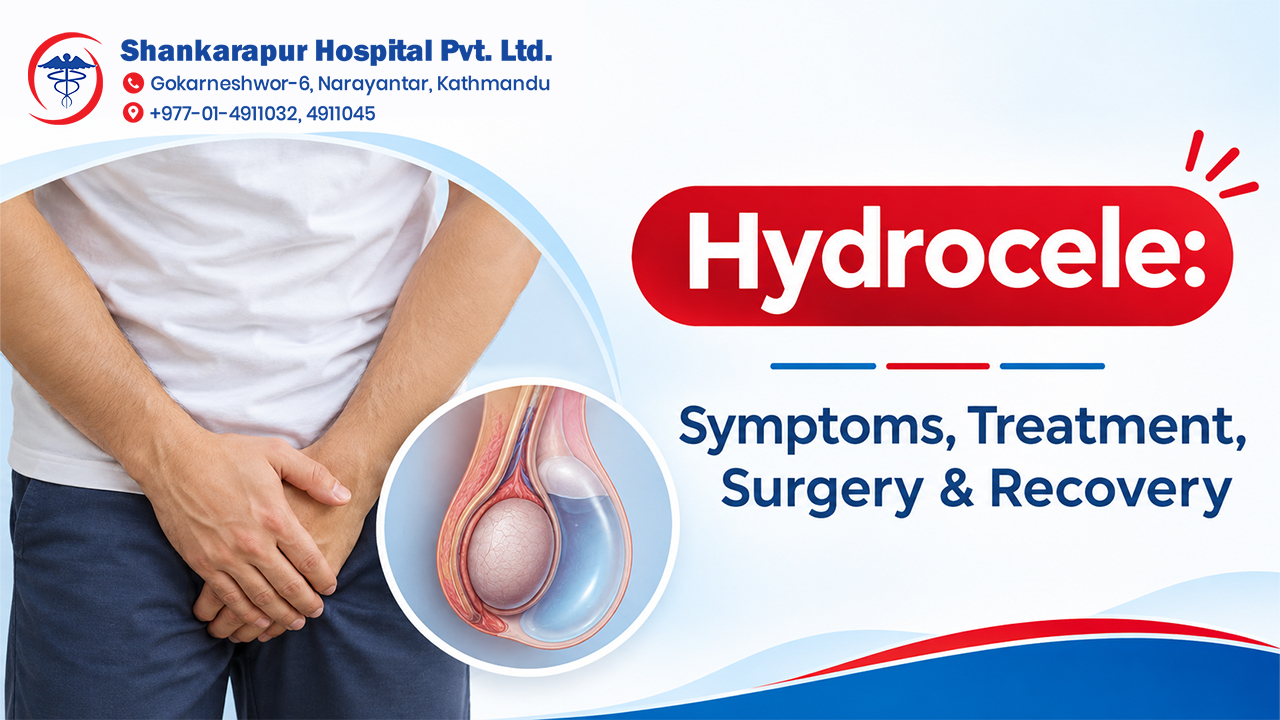
A hydrocele is a collection of fluid around a testicle that causes swelling of the scrotum. It usually develops without significant pain, although larger hydroceles can cause heaviness, discomfort or difficulty with everyday activities.
Hydroceles can occur in newborn babies, children and adult men. Many hydroceles in infants disappear naturally, while adults with persistent or troublesome swelling may need treatment. Surgery, called hydrocelectomy, is one option when a hydrocele causes symptoms or does not resolve.
However, not every swollen scrotum is caused by a hydrocele. Inguinal hernias, infections and testicular conditions can produce similar symptoms. New or unexplained swelling should therefore be examined by a healthcare professional.
This guide explains hydrocele symptoms, causes, diagnosis, treatment options, surgery, recovery and when to consult a urologist in Kathmandu.
Important: Sudden or severe testicular pain, particularly with nausea or vomiting, requires immediate emergency medical attention. Do not assume that painful swelling is simply a hydrocele.
What Is a Hydrocele?
A hydrocele is an abnormal accumulation of fluid within the thin covering surrounding a testicle, known as the tunica vaginalis.
The scrotum is the pouch of skin that contains the testicles. Normally, a small amount of fluid around the testicle helps its surrounding tissues move smoothly. A hydrocele develops when excess fluid accumulates or normal fluid drainage is disrupted.
The result is a swollen scrotum that may feel smooth, rounded or similar to a water-filled balloon.
Hydroceles can affect one side or both sides of the scrotum. Their size may remain stable, increase gradually or change during the day, depending on the type and underlying cause.
A hydrocele is different from swelling inside the testicle itself. That distinction is important because a lump or abnormality within the testicle may need a different investigation.
According to Cleveland Clinic's hydrocele information, swelling is the main symptom, and surgery may be considered for hydroceles that do not resolve or cause problems.
What Are the Symptoms of Hydrocele?
The most recognizable hydrocele symptom is swelling on one or both sides of the scrotum.
A small hydrocele may cause few noticeable problems. A larger one can produce uncomfortable pressure or heaviness.
Common symptoms include:
-
Painless swelling of the scrotum.
-
One side of the scrotum appearing larger than the other.
-
A smooth or rounded swelling around a testicle.
-
A feeling of heaviness or pressure.
-
Mild aching or discomfort, particularly with larger swelling.
-
Difficulty walking, sitting comfortably or undertaking certain activities when the swelling is substantial.
In some cases, the swelling changes in size during the day.
Does hydrocele cause severe pain?
An uncomplicated hydrocele is usually painless or only mildly uncomfortable. Sudden, intense testicular pain is not typical and needs urgent assessment.
A man may have a hydrocele and a separate condition at the same time. Therefore, the presence of a known hydrocele should not be used to dismiss new symptoms.
What Causes Hydrocele?
The causes of hydrocele differ between infants and adults.
Hydrocele in newborn babies
During pregnancy, the testicles develop in the abdomen and normally descend into the scrotum through a passage in the groin.
This passage, called the processus vaginalis, ordinarily closes around the time of birth.
If it remains open, fluid from the abdominal cavity can travel into the space surrounding the testicle and produce a hydrocele.
Sometimes the passage closes, but fluid already present around the testicle remains temporarily.
Many infant hydroceles improve naturally as the child's body absorbs the fluid.
Hydrocele in adults
In adults, a hydrocele can develop when the balance between fluid production and absorption around the testicle changes.
Possible contributing factors include:
-
Inflammation of the testicle or surrounding structures.
-
Injury or trauma involving the scrotum.
-
Infection or inflammation of the epididymis or testicle.
-
Previous surgery or changes affecting local fluid drainage.
-
Fluid accumulation without an obvious identifiable cause.
An adult hydrocele may develop slowly over weeks or months.
Sometimes the cause is not immediately apparent. The priority is to confirm that the swelling is actually a hydrocele and to investigate any suspicious underlying condition.
The MedlinePlus medical encyclopedia explains that hydroceles can result from the accumulation of fluid around the testicle and may be associated with injury or inflammation.
Types of Hydrocele
Hydroceles are commonly divided into communicating and non-communicating types.
1. Communicating hydrocele
A communicating hydrocele occurs when a passage remains open between the abdominal cavity and the area around the testicle.
Fluid can move through this passage, and the swelling may change in size during the day.
For example, it may become more noticeable when a child is active and smaller after lying down.
A communicating hydrocele is important to distinguish from an inguinal hernia, in which abdominal tissue may enter the groin or scrotum.
2. Non-communicating hydrocele
In a non-communicating hydrocele, there is no open connection allowing fluid to move freely between the abdomen and scrotum.
Fluid remains around the testicle because it has not been absorbed normally or because fluid production and drainage are out of balance.
The swelling may remain relatively constant, although its size can change gradually.
The European Association of Urology's pediatric hydrocele guidance describes these differences and explains why the type of hydrocele can influence management in children.
Is Hydrocele Dangerous?
Most uncomplicated hydroceles are not dangerous and do not require emergency surgery.
Nevertheless, a hydrocele should not be diagnosed solely by looking at or touching the scrotum at home.
Persistent swelling can sometimes occur alongside another condition. A medical examination helps distinguish a simple fluid collection from an inguinal hernia, inflammation or a testicular mass.
When should you seek immediate medical attention?
Go to an emergency department immediately if you experience:
-
Sudden, severe pain in one or both testicles.
-
Testicular pain accompanied by nausea, vomiting or abdominal pain.
-
Rapidly developing painful scrotal swelling.
-
Significant scrotal pain after an injury.
-
Severe pain with marked redness, fever or feeling seriously unwell.
One important emergency is testicular torsion, in which the spermatic cord twists and reduces blood flow to the testicle. Treatment may be time-sensitive.
A painful, irreducible groin or scrotal bulge accompanied by vomiting may also indicate a complicated hernia.
The NHS guidance on testicular lumps and swelling recommends prompt medical examination for unexplained lumps and immediate emergency care for sudden severe testicular pain.
Hydrocele vs Other Scrotal Conditions
Several conditions can produce swelling in the scrotum, but they do not all require the same treatment.
| Condition | Typical features | Why assessment matters |
|---|---|---|
| Hydrocele | Fluid-related swelling, often painless | Confirm the fluid collection and exclude another cause |
| Inguinal hernia | Groin or scrotal bulge that may change with coughing or straining | Some hernias require surgical treatment |
| Varicocele | Enlarged veins, sometimes described as feeling like a bag of worms | May cause aching and sometimes fertility concerns |
| Epididymitis | Tenderness, swelling and sometimes fever or urinary symptoms | Infection or inflammation may need treatment |
| Spermatocele | Fluid-filled cyst usually near the epididymis | Different location and management |
| Testicular tumour | May cause a firm lump or testicular change | Requires timely medical investigation |
| Testicular torsion | Sudden severe pain, often with swelling | A surgical emergency |
Symptoms overlap. Even a swelling that appears harmless should be examined if it is new, persistent or increasing.
For further information about other causes of discomfort, see Shankarapur Hospital's article on testicle pain, warning signs and treatment options.
How Is Hydrocele Diagnosed?
Hydrocele diagnosis usually begins with a medical history and physical examination.
A doctor may ask when the swelling first appeared, whether its size changes, whether pain is present and whether there has been any recent injury, infection or groin surgery.
The examination may involve checking both testicles, examining the groin and assessing the characteristics of the swelling.
Physical examination
A doctor evaluates the location, size, tenderness and consistency of the swelling.
The doctor may also assess whether an inguinal hernia is present.
Transillumination
Transillumination involves shining a light through the swollen scrotum.
A fluid-filled hydrocele may allow light to pass through it, which can support the diagnosis.
However, transillumination alone cannot reliably exclude all other conditions.
Scrotal ultrasound
Ultrasound uses sound waves to create images of the testicles and surrounding tissues.
A scrotal ultrasound may help a clinician:
-
Confirm the presence of fluid around the testicle.
-
Examine the testicle when swelling makes it difficult to feel.
-
Identify a possible mass or another cause of swelling.
-
Evaluate an associated hernia or other abnormality when indicated.
Doppler ultrasound may be used to assess blood flow when clinically appropriate.
Ultrasound is not required in exactly the same way for every patient, and imaging must not delay emergency treatment when testicular torsion is strongly suspected.
Mayo Clinic's hydrocele diagnosis guidance describes physical examination, transillumination and ultrasound as important assessment methods.
Shankarapur Hospital lists ultrasound and color Doppler among its diagnostic and imaging services. Patients should confirm the relevant examination and appointment arrangements directly with the hospital.
Can Hydrocele Go Away Without Surgery?
Yes, some hydroceles resolve without surgery, but the likelihood depends on the patient's age, type of hydrocele and underlying cause.
In babies and young children
Many hydroceles disappear naturally during infancy.
The European Association of Urology recommends observation for most infant hydroceles during at least the first year, provided there is no concern about an associated hernia or underlying testicular condition.
Persistent or unusual swelling requires reassessment, and the timing of any operation depends on individual clinical findings.
In adults
Some adult hydroceles may remain small and stable without causing significant problems.
Occasionally, swelling related to a temporary inflammatory process may improve.
However, established adult hydroceles are generally less likely to disappear naturally than uncomplicated infant hydroceles.
For this reason, observation is a management option rather than a guarantee that the fluid will vanish.
The decision to treat depends on symptoms and examination findings, not simply the presence of fluid.
Hydrocele Treatment Options
There is no single treatment suitable for every hydrocele.
The main approaches are observation, treatment of an underlying condition when present, and surgical repair.
| Treatment approach | When it may be appropriate | Main limitation |
|---|---|---|
| Observation | Small, uncomplicated or minimally symptomatic hydrocele | Requires appropriate diagnosis and reassessment |
| Treatment of underlying illness | Associated infection or inflammatory condition | May not eliminate a persistent fluid collection |
| Hydrocelectomy | Persistent, large or troublesome hydrocele | Involves an operation and recovery |
| Needle aspiration | Selected patients when surgery is unsuitable | Fluid often returns, and complications can occur |
Observation and follow-up
If the hydrocele is not causing significant symptoms and examination does not reveal a concerning cause, a clinician may recommend monitoring.
Patients should report increasing swelling, new pain or changes in the testicle.
Can medicine cure hydrocele?
There is no established tablet or cream that reliably removes an uncomplicated hydrocele.
Medication may be needed for an associated infection or inflammatory condition, but that is different from treating the fluid-filled sac itself.
Can the fluid be removed using a needle?
Needle aspiration involves withdrawing fluid from the hydrocele.
Although this can reduce swelling temporarily, the fluid frequently accumulates again because aspiration does not necessarily correct the underlying problem.
Aspiration also carries risks, including infection and bleeding. It is not generally the preferred definitive treatment for an otherwise suitable surgical patient.
Patients should never attempt to puncture or drain a hydrocele themselves.
When Is Hydrocele Surgery Recommended?
Hydrocele surgery may be considered when swelling becomes uncomfortable, interferes with daily activities or persists despite appropriate observation.
A urologist or surgeon may discuss an operation when:
-
The hydrocele is large or continues to enlarge.
-
Heaviness or discomfort affects normal activities.
-
Swelling creates substantial physical inconvenience.
-
A persistent hydrocele is unlikely to resolve.
-
Clinical findings suggest that surgical evaluation is necessary.
In children, an associated inguinal hernia or suspicious testicular finding may change the urgency and approach to treatment.
Surgery is not automatically necessary merely because a hydrocele is visible.
Before deciding, the patient and clinician should discuss the diagnosis, expected benefits, alternatives, operative risks and recovery requirements.
How Is Hydrocele Surgery Performed?
Hydrocele surgery is called a hydrocelectomy or hydrocele repair.
The objective is to manage the fluid-filled sac so that problematic fluid accumulation is less likely to continue.
Before the operation
The surgical team reviews the patient's medical history, medications, allergies and relevant investigations.
The type of anesthesia depends on the patient's circumstances, the procedure and the anesthetist's assessment.
Patients should follow the hospital's specific fasting and medication instructions.
During the operation
For a typical adult scrotal hydrocele, the surgeon usually makes an incision in the scrotum.
The fluid is drained, and the surrounding sac is treated. Depending on the surgical technique, part of the sac may be removed, folded or repositioned.
The surgeon then closes the wound, often using dissolvable stitches.
The operation for a communicating hydrocele in a child is different. It commonly involves an incision in the groin to close the open passage through which fluid moves.
The exact technique should be explained by the treating surgeon.
After the operation
Some patients can return home on the same day following appropriate assessment and recovery from anesthesia. Others may need additional observation or admission.
Dressings, supportive underwear and occasionally temporary drainage may be used.
Hydrocelectomy is a recognized surgical treatment, but like any operation it has risks, and the hydrocele can occasionally return.
Recovery After Hydrocele Surgery
Recovery varies according to the size of the hydrocele, the surgical technique, the patient's general health and the type of work they perform.
Mild discomfort, swelling and bruising are common during the first days after surgery. These symptoms should gradually improve, although the scrotum may remain swollen for several weeks.
Practical recovery advice
Patients are generally advised to:
-
Rest during the initial recovery period.
-
Wear supportive underwear if recommended.
-
Keep the surgical wound clean and dry according to discharge instructions.
-
Take pain medication only as directed.
-
Avoid heavy lifting, strenuous exercise and pressure on the surgical area until cleared by the surgeon.
-
Attend follow-up appointments as recommended.
The timing of returning to work depends on the nature of the job. Someone doing desk-based work may return sooner than someone whose work involves lifting or prolonged physical activity.
Sexual activity, cycling and exercise should resume only when healing is sufficient and the surgical team advises that they are safe.
According to Frimley Health NHS Foundation Trust's hydrocele repair guidance, patients may experience postoperative swelling and tenderness and are advised to avoid heavy lifting and strenuous activity for approximately four weeks.
Warning signs after surgery
Contact the surgical team promptly if you develop fever, increasing redness, worsening pain, unusual wound discharge, significant bleeding or increasing swelling rather than gradual improvement.
Sudden severe testicular pain or serious symptoms after surgery require emergency assessment.
What Are the Risks of Hydrocele Surgery?
Hydrocelectomy is a commonly performed operation, but no surgical procedure is completely free from risk.
Possible complications include:
-
Bleeding or a collection of blood within the scrotum, called a hematoma.
-
Wound infection.
-
Persistent swelling or discomfort.
-
Delayed wound healing.
-
Scarring.
-
Recurrence of the hydrocele.
-
Injury to the testicle, epididymis or surrounding structures.
-
Complications related to anesthesia.
Serious injury is uncommon, but the individual risks vary depending on the clinical situation, surgical technique and medical history.
The surgeon should explain the expected benefits and potential complications before obtaining informed consent.
The Cleveland Clinic hydrocelectomy guide also identifies infection, hematoma, recurrence and injury to nearby structures as potential complications.
Can hydrocele return after surgery?
Yes. Recurrence is possible even after hydrocelectomy.
However, surgical repair aims to provide a more lasting result than simply draining the fluid with a needle.
Persistent or recurrent swelling should be reassessed instead of assuming that the original hydrocele has returned.
Does Hydrocele Affect Fertility?
A simple hydrocele generally does not directly cause infertility.
The fluid accumulates around the testicle rather than inside it. Nevertheless, certain underlying conditions associated with scrotal swelling can affect reproductive health.
For example, infection, testicular injury or another abnormality may require separate evaluation.
Very large or longstanding hydroceles can occasionally raise additional clinical concerns, and surgical complications involving reproductive structures may affect fertility in rare cases.
Men experiencing difficulty conceiving should discuss their reproductive health with a qualified specialist rather than assuming that the hydrocele is the cause.
Hydrocele Treatment in Kathmandu, Nepal
People experiencing persistent scrotal swelling in Kathmandu should seek an appropriate medical assessment before deciding on treatment.
A consultation can help establish whether the swelling is caused by a hydrocele or another condition that requires different management.
A healthcare professional may recommend examination, ultrasound or further investigations depending on the findings.
Where can patients seek a urology consultation?
Shankarapur Hospital, located in Jorpati, Narayantaar, Kathmandu, has a Urology Department that provides evaluation and management of urological conditions.
The hospital also publishes information about its outpatient and clinical services and diagnostic and imaging services.
Patients can review the hospital's urology specialist profile or contact the hospital to confirm the appropriate consultation arrangements.
Service clarification: Patients should directly confirm whether hydrocele-specific surgical assessment, hydrocelectomy and any required anesthesia services are available before making treatment plans.
What should you ask before hydrocele surgery in Kathmandu?
When comparing treatment options, useful questions include:
-
Has the diagnosis been confirmed, and is an ultrasound needed?
-
Is surgery necessary now, or can the swelling be monitored?
-
Which surgical approach is suitable for my condition?
-
What type of anesthesia will be used?
-
What are the expected benefits and complications?
-
What is included in the estimated treatment cost?
-
Will admission or a caregiver be necessary?
-
When can I return to work and physical activity?
-
What follow-up appointments will be needed?
An individualized cost estimate may depend on the consultation, investigations, procedure, anesthesia, medicines, admission and follow-up arrangements.
Do not rely on advertised prices without confirming exactly what they include.
Frequently Asked Questions About Hydrocele
Is hydrocele a form of cancer?
No. A hydrocele is a fluid collection, not cancer. However, scrotal swelling can sometimes occur alongside another condition, including a testicular tumour. An examination and appropriate imaging can help identify the cause.
Can hydrocele be cured permanently?
Surgery can provide lasting treatment, but recurrence remains possible. The outcome depends on the type of hydrocele and individual clinical factors.
Is walking safe with hydrocele?
Walking is generally possible if a hydrocele is small and not painful. A large hydrocele may cause discomfort or heaviness. Activities that cause pain should be discussed with a clinician.
Can hydrocele be treated with home remedies?
There is no reliable evidence that massage, herbal preparations or home remedies eliminate an established hydrocele. Attempting to puncture or drain it at home can cause serious harm.
Does hydrocele always require an operation?
No. Small, uncomplicated hydroceles may be observed, and many infant hydroceles resolve naturally. Surgery is considered when it is clinically indicated.
How much does hydrocele surgery cost in Nepal?
The cost varies by hospital, investigations, surgical approach, anesthesia, admission and follow-up needs. Patients should request an itemized estimate from their healthcare provider. A specific hydrocele surgery price has not been verified for Shankarapur Hospital.
Which doctor treats hydrocele?
A urologist commonly assesses and treats hydroceles in adults. Pediatric surgeons or pediatric urologists may manage hydroceles in children, depending on the clinical circumstances and local service availability.
Final Takeaway
A hydrocele is a collection of fluid around the testicle that usually causes painless scrotal swelling. Although many cases are uncomplicated, a proper medical examination is important to confirm the diagnosis and rule out other causes.
Not every hydrocele needs surgery. Management depends on age, symptoms, size, underlying conditions and the patient's preferences.
When surgery is appropriate, hydrocelectomy can offer lasting relief, but the decision should include a discussion of risks, benefits, alternatives and recovery.
If you have persistent or unexplained scrotal swelling, consider arranging a professional medical assessment.
For information about urology consultations in Kathmandu, visit the Shankarapur Hospital Urology Department, request an appointment, or contact the hospital.
Medical notice: This article provides general health education and does not replace diagnosis or treatment advice from a qualified healthcare professional. Sudden severe testicular pain requires emergency medical attention.