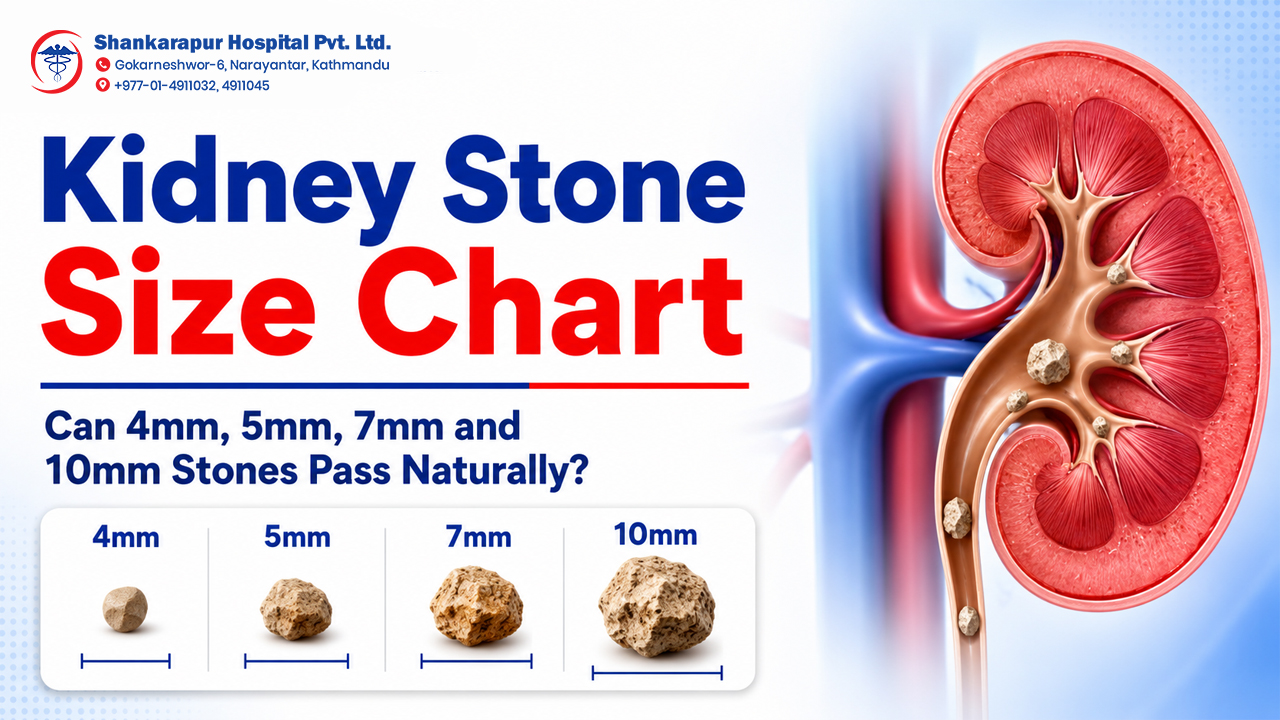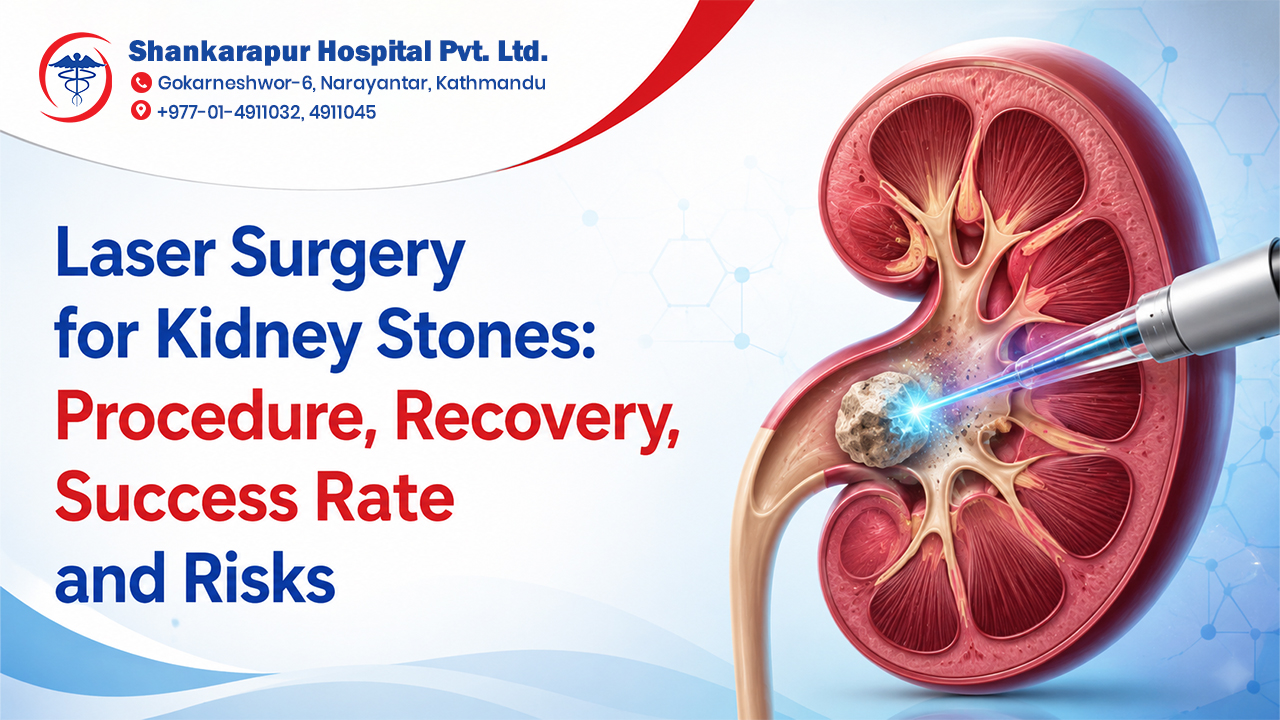
Laser Surgery for Kidney Stones is a minimally invasive urology procedure used to break kidney or ureter stones into smaller pieces using laser energy. It is commonly performed through a thin scope passed through the natural urinary passage, so it usually does not require a large cut on the body.
For patients in Nepal looking for kidney stone surgery, laser treatment may be one option depending on the stone size, location, symptoms, kidney function, infection risk, and the urologist’s assessment.
Not every kidney stone needs surgery. Small stones may pass with medicines, hydration, and monitoring. Larger stones, blocked urine flow, infection, severe pain, or stones that do not pass may need hospital-based treatment.
Medical note: This article is for patient education only. It should not replace consultation, diagnosis, or treatment from a qualified urologist.
What Is Laser Surgery for Kidney Stones?
Laser surgery for kidney stones is often called ureteroscopy with laser lithotripsy.
During this procedure, a urologist passes a thin instrument called a ureteroscope through the urethra and bladder into the ureter or kidney. The stone is seen directly through the scope. A laser fiber is then used to break the stone into dust-like particles or smaller fragments.
Some fragments may pass naturally through urine. Others may be removed using a small basket.
NIDDK explains that during ureteroscopy, a doctor uses a ureteroscope to view the ureters and kidneys, and stones may be removed or broken into smaller pieces when needed.
Laser lithotripsy can be used for stones in the ureter and selected stones inside the kidney. Cleveland Clinic describes laser lithotripsy as a procedure used to break up and remove stones in the kidney, bladder, ureter, or urethra, usually by passing the laser through a scope in the urinary tract.
Is Laser Surgery Good for Kidney Stones?
Yes, laser surgery can be a good treatment for many kidney and ureter stones, especially when the stone is unlikely to pass naturally, is causing blockage, or needs direct treatment.
However, the best option depends on the patient’s condition.
|
Situation |
Laser Surgery May Help When |
|
Ureter stone |
The stone is stuck or causing severe pain |
|
Kidney stone |
The stone is suitable for flexible ureteroscopy or RIRS |
|
Failed medicine treatment |
The stone does not pass with conservative care |
|
Recurrent symptoms |
Pain, bleeding, or urinary blockage keeps returning |
|
Need for direct treatment |
The urologist wants to see and break the stone directly |
Laser treatment is not automatically the best choice for every stone. Very large stones may need PCNL, while some smaller stones may be managed with medicines or shock wave lithotripsy.
Why Kidney Stones Need Proper Evaluation
Kidney stones are hard deposits made from minerals and salts. They can form inside the kidney and may move into the ureter, the tube that carries urine from the kidney to the bladder.
Kidney stones are common. NIDDK reports that about 11% of men and 6% of women in the United States have kidney stones at least once in their lifetime. (NIDDK)
A stone may stay silent inside the kidney. Symptoms often start when the stone moves, blocks urine flow, or irritates the urinary tract.
Common symptoms include:
- Severe pain in the side, back, lower abdomen, or groin
- Blood in urine
- Burning urination
- Frequent urination
- Nausea or vomiting
- Fever or chills if infection is present
- Difficulty passing urine
Mayo Clinic notes that kidney stone symptoms may include severe pain, nausea, vomiting, fever, chills, and blood in the urine, especially when a stone moves into the ureter.
At Shankarapur Hospital, patient education content also mentions kidney stone symptoms such as sharp side or lower back pain, blood in urine, nausea, vomiting, and difficulty urinating.
When Is Kidney Stone Surgery Needed?
Not every stone needs an operation. A urologist may recommend observation, pain medicine, hydration, and medicine to help stone passage for selected small stones.
Surgery or a procedure may be needed when:
|
Reason for Treatment |
Why It Matters |
|
Severe pain |
Pain is not controlled with medicine |
|
Blocked urine flow |
Obstruction can affect kidney function |
|
Infection with obstruction |
This can become a medical emergency |
|
Large stone |
Less likely to pass naturally |
|
Stone not passing |
Symptoms continue despite treatment |
|
Repeated attacks |
Recurring pain affects daily life |
|
Single kidney or kidney disease |
Requires careful protection of kidney function |
The European Association of Urology states that an obstructed kidney with signs of urinary tract infection or anuria is a urological emergency and often needs urgent decompression.
This is why fever with stone pain should never be ignored.
Types of Kidney Stone Treatment in Nepal
Patients searching for kidney stone treatment in Nepal may come across several treatment options. The right treatment depends on stone size, location, hardness, symptoms, infection status, and available expertise.
|
Treatment Option |
How It Works |
Common Use |
|
Conservative treatment |
Pain control, hydration, monitoring, selected medicines |
Small stones likely to pass |
|
ESWL |
Shock waves break stone from outside the body |
Selected kidney or upper ureter stones |
|
URS with laser lithotripsy |
Scope and laser break stone from inside urinary tract |
Ureter stones and selected kidney stones |
|
RIRS |
Flexible scope reaches kidney from natural urinary passage |
Selected kidney stones |
|
PCNL |
Small back incision to remove larger kidney stones |
Large or complex kidney stones |
|
Open surgery |
Larger incision |
Rarely used today |
NHS lists treatment-related complications for large kidney stones and notes that risk depends on the type of treatment, stone size, and stone position.
Shankarapur Hospital lists Urology among its departments and also lists diagnostic, OPD, inpatient, and emergency services, which are important for kidney stone evaluation and treatment planning.
How Laser Kidney Stone Surgery Works
Laser kidney stone surgery usually follows a structured process.
1. Evaluation Before Surgery
The urologist reviews symptoms, medical history, urine tests, kidney function, imaging, infection risk, and medicines.
Tests may include:
- Urine routine and culture
- Blood tests
- Kidney function tests
- Ultrasound
- X-ray KUB
- CT scan when needed
A good urology hospital should have access to urine testing, imaging, specialist consultation, and inpatient support for urgent cases. Shankarapur Hospital Urology, diagnostic and imaging services, OPD services, inpatient services, and emergency care.
2. Anaesthesia
Laser lithotripsy is commonly performed under anaesthesia so the patient does not feel the procedure while it is being done.
The exact anaesthesia plan depends on the patient’s health, stone location, procedure type, and anaesthesiologist’s assessment.
3. Scope Insertion
The urologist passes a thin scope through the urethra into the bladder and then into the ureter or kidney.
No large external incision is usually required for ureteroscopy-based laser lithotripsy.
4. Laser Fragmentation
The stone is broken using laser energy.
The urologist may either fragment the stone into pieces or dust it into tiny particles.
5. Fragment Removal
Some fragments may be removed using a small basket. Smaller particles may pass naturally in urine after surgery.
6. Stent Placement
A temporary ureteric stent may be placed in some cases. A stent is a small tube that helps urine drain from the kidney to the bladder while swelling settles.
Stents can cause temporary urinary symptoms, but they are often useful after the procedure.
Laser Surgery for Kidney Stones vs Other Treatments
Laser surgery is one important option, but it is not the only one.
|
Factor |
Laser Surgery / URS |
ESWL |
PCNL |
|
Method |
Scope enters urinary tract; laser breaks stone |
Shock waves from outside body |
Small incision in back to access kidney |
|
Skin cut |
Usually no skin cut |
No skin cut |
Small cut |
|
Best for |
Ureter stones, selected kidney stones |
Selected smaller stones |
Large or complex kidney stones |
|
Anaesthesia |
Usually needed |
Depends on setting |
Usually needed |
|
Stone clearance |
Often high for suitable stones |
May need repeat sessions |
High for large stones |
|
Recovery |
Often shorter than major surgery |
Usually short |
Longer than URS/ESWL |
|
Risks |
Infection, bleeding, ureter injury, stent discomfort |
Pain, bruising, fragments, infection |
Bleeding, infection, kidney injury risk |
The National Kidney Foundation notes that ureteroscopy has a greater chance of removing all kidney stones compared with extracorporeal shock wave lithotripsy for suitable cases.
A comparison study also found PCNL had the highest stone-free rate for renal stones, while shock wave lithotripsy had the lowest stone-free rate among the compared surgical options.
The practical message is simple: each treatment has a role. The “best” option depends on the stone and the patient.
Benefits of Laser Surgery for Kidney Stones
Laser surgery has several advantages when used for the right patient.
1. Minimally Invasive Approach
Ureteroscopy-based laser treatment usually reaches the stone through the natural urinary passage. This avoids a large surgical incision.
2. Direct Stone Visualization
The urologist can directly see the stone through the scope and target it with laser energy.
This is different from shock wave lithotripsy, where energy is focused from outside the body.
3. Useful for Ureter Stones
Laser lithotripsy is commonly used for stones stuck in the ureter, especially when pain, obstruction, or failure to pass becomes a problem.
4. Can Treat Different Stone Types
Laser energy can fragment many stone compositions, although treatment difficulty can vary depending on hardness, size, and location.
5. Shorter Recovery Than Open Surgery
Compared with open surgery, ureteroscopy and laser lithotripsy generally involve smaller trauma and a faster return to daily activity.
How Painful Is Laser Kidney Stone Removal?
Laser kidney stone removal is usually performed under anaesthesia, so patients generally should not feel the stone being broken during the procedure.
After surgery, some discomfort is common.
Patients may feel:
- Burning while urinating
- Mild blood in urine
- Urinary frequency or urgency
- Flank or bladder discomfort
- Stent-related irritation
- Pain for a few days
After cystoscopy or ureteroscopy, patients may have mild burning during urination, small amounts of blood in urine, mild bladder or kidney discomfort, and more frequent or urgent urination.
Pain level varies. Some patients feel mild discomfort, while others have stronger stent-related symptoms. The urology team usually provides pain medicines and instructions.
Recovery Time After Laser Surgery for Kidney Stones
Recovery depends on the procedure, stone burden, anaesthesia, stent use, infection, and overall health.
For many uncomplicated ureteroscopy and laser lithotripsy cases, patients may return to light activities within a few days. Some may need more time, especially if a stent is placed or the procedure was difficult.
|
Recovery Area |
Usual Expectation |
|
Hospital stay |
Same day or short stay in many uncomplicated cases |
|
Burning urination |
May last a few days |
|
Blood in urine |
Often improves within a few days |
|
Stent discomfort |
May continue until stent removal |
|
Light activity |
Often within a few days if feeling well |
|
Work |
Often within several days, depending on job and symptoms |
|
Heavy lifting |
Avoid until cleared by doctor |
|
Follow-up |
Needed for stent removal, imaging, or prevention advice |
Patients may resume work after 7 to 10 days if feeling well after flexible ureteroscopy, while University of Utah Health gives a shorter two-to-three-day estimate for many ureteroscopy and laser lithotripsy patients. These differences show why recovery advice should be individualized.
What Is the Success Rate of Kidney Stone Laser Treatment?
The success rate of laser kidney stone treatment depends on stone size, location, number of stones, anatomy, infection, surgeon experience, equipment, and how “stone-free” is defined.
Many studies report high success rates for suitable ureter and kidney stones, but not every patient becomes completely stone-free after one session.
A 2023 real world ureteroscopy study noted that early reports showed stone-free rates above 90%, but also emphasized that real-world stone-free outcomes can vary due to differences in stone complexity and definitions.
A study of ureteroscopy with laser lithotripsy reported success rates commonly ranging from 85% to 95%, with an overall stone-free rate of 90% in that study.
A balanced patient answer is: laser treatment often works well for suitable stones, but success is not guaranteed. Some patients may need a second procedure, stent management, follow-up imaging, or preventive treatment.
Side Effects of Kidney Stone Laser Surgery
Most side effects after laser lithotripsy are temporary, but patients should know what to expect.
Common side effects may include:
|
Side Effect |
What It Means |
|
Blood in urine |
Often temporary after scope treatment |
|
Burning urination |
May happen due to irritation |
|
Frequent urination |
Common if a stent is placed |
|
Flank or bladder pain |
May be procedure or stent related |
|
Passing fragments |
Small stone pieces may pass in urine |
|
Nausea |
May relate to anaesthesia or pain medicine |
|
Fatigue |
Common after anaesthesia or procedure stress |
Patients should follow discharge instructions and drink fluids as advised by their doctor.
Risks of Laser Removal of Kidney Stones
Like any medical procedure, laser surgery has risks.
Possible risks include:
- Urinary tract infection
- Fever or sepsis
- Bleeding
- Ureter injury
- Ureter narrowing or stricture
- Pain from stone fragments
- Stone fragments left behind
- Need for repeat procedure
- Stent discomfort
- Anaesthesia-related risks
Serious complications are uncommon in many routine cases, but they can happen. This is why proper pre-surgery evaluation, sterile technique, imaging, follow-up, and early reporting of warning signs are important.
Warning Signs After Laser Kidney Stone Surgery
Contact your urologist or seek urgent care if you develop:
- Fever or chills
- Severe pain not controlled by medicine
- Inability to pass urine
- Heavy bleeding or clots in urine
- Persistent vomiting
- Worsening weakness
- Severe burning with fever
- Stent-related pain that becomes unbearable
Preparing for Laser Kidney Stone Surgery
Before surgery, the hospital team may advise tests and preparation steps.
Patients may be asked to:
- Share all medicines and allergies
- Report blood thinner use
- Complete urine and blood tests
- Treat urine infection before surgery if present
- Follow fasting instructions
- Arrange someone to accompany them
- Discuss anaesthesia risk
- Ask about stent placement and removal
- Understand follow-up schedule
Do not stop prescribed medicines without medical advice. Blood thinners, diabetes medicines, and blood pressure medicines need individualized instructions.
What to Ask Your Urologist Before Surgery
Patients often feel anxious before kidney stone surgery. Asking the right questions helps.
|
Question |
Why It Helps |
|
Where exactly is my stone? |
Location affects treatment choice |
|
How large is the stone? |
Size affects success and procedure type |
|
Is laser surgery the best option for me? |
Confirms suitability |
|
Will I need a stent? |
Helps prepare for symptoms |
|
Can the stone be fully removed in one session? |
Sets realistic expectations |
|
What are the risks in my case? |
Individual risk varies |
|
When can I return to work? |
Helps plan recovery |
|
How can I prevent future stones? |
Reduces recurrence risk |
Good care is not only about removing the current stone. It also includes preventing the next one.
Kidney Stone Surgery in Nepal: Why Hospital Setup Matters
Patients searching for a urology hospital in Nepal or kidney stone surgery in Nepal should look beyond marketing claims.
A good urology setup should provide:
- Urologist-led assessment
- Emergency care for severe pain or infection
- Urine and blood testing
- Imaging support
- Procedure and surgery planning
- Inpatient support when needed
- Follow-up and prevention counselling
Shankarapur Hospital is a multispecialty hospital in Kathmandu that publicly lists Urology among its departments. Its website also lists diagnostic and imaging services, OPD services, inpatient and ward services, and emergency care.
The hospital’s urology education content states that larger stones may require medical intervention and that its urology department offers diagnostic tools and treatments to manage kidney stones.
For patients in Kathmandu, location, emergency access, imaging availability, specialist consultation, and follow-up are practical factors when choosing a hospital.
Preventing Kidney Stones After Laser Treatment
Laser surgery can treat an existing stone, but it does not automatically prevent new stones.
Prevention depends on the stone type and patient risk factors.
General prevention steps may include:
- Drinking enough water unless restricted by a doctor
- Reducing excess salt intake
- Avoiding dehydration
- Managing weight and metabolic conditions
- Not overusing supplements without advice
- Following dietary guidance based on stone type
- Testing stone composition when possible
- Follow-up imaging if recommended
Some patients need metabolic evaluation, especially if stones are recurrent, multiple, early-onset, or associated with other medical conditions.
Final Thoughts
Laser Surgery for Kidney Stones is a commonly used minimally invasive treatment for suitable kidney and ureter stones. It allows the urologist to reach the stone through the urinary tract, break it using laser energy, and remove or allow passage of fragments.
It can be a good option for many patients, but it is not the right choice for every stone.
The best kidney stone treatment depends on stone size, location, symptoms, infection, kidney function, patient health, and urologist recommendation.
Patients looking for kidney stone treatment in Nepal should choose a hospital that can provide proper evaluation, imaging, urology consultation, procedure planning, emergency support, and follow-up care.
If you have severe side pain, blood in urine, vomiting, fever, chills, or difficulty passing urine, seek medical evaluation promptly.
FAQs
How painful is laser kidney stone removal?
Laser kidney stone removal is usually done under anaesthesia, so patients generally do not feel the procedure. After surgery, mild to moderate burning urination, blood in urine, stent discomfort, or flank pain may occur for a few days.
Is laser surgery good for kidney stones?
Yes, laser surgery is good for many kidney and ureter stones when the stone is stuck, painful, blocking urine flow, or unlikely to pass naturally. The best treatment depends on stone size, location, infection risk, and urologist assessment.
How long does it take to recover from laser surgery for kidney stones?
Many patients recover from ureteroscopy and laser lithotripsy within a few days to about one week. Recovery may take longer if a stent is placed, infection is present, or the procedure is complex.
What is the success rate of kidney stone laser treatment?
Success rates vary by stone size, location, number of stones, and definition of stone-free status. Many studies report high success rates for suitable stones, often around 85% to 95%, but some patients may need repeat treatment or follow-up.
What are the side effects of kidney stone laser surgery?
Common side effects include burning urination, blood in urine, frequent urination, bladder discomfort, flank pain, stent irritation, and passing small stone fragments. These are often temporary but should be monitored.
What are the risks of laser removal?
Risks include urinary infection, fever, bleeding, ureter injury, ureter narrowing, retained stone fragments, pain, stent discomfort, anaesthesia-related risks, and the possibility of needing another procedure.
Author: Shankarapur Hospital Health Education Team
Shankarapur Hospital is a multispecialty hospital in Gokarneshor-06, Jorpati, Narayantaar, Kathmandu, Nepal. Its services include OPD, emergency care, diagnostic and imaging services, inpatient care, and specialist departments including Urology. This article is for patient education and should be reviewed by a qualified urologist before publication.